
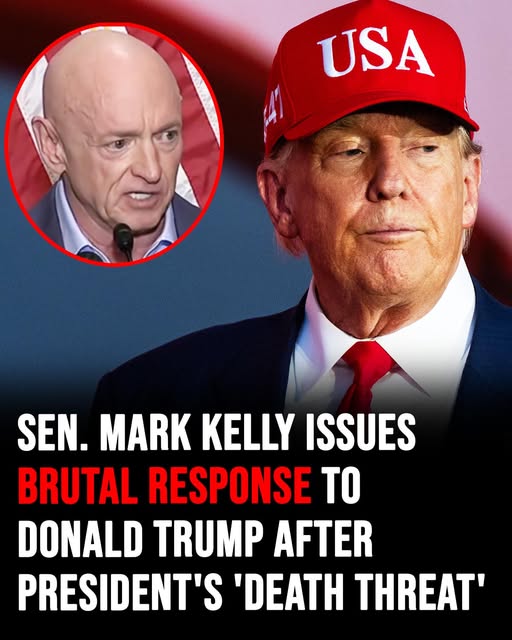
Mark Kelly’s answer to Trump’s escalation was not a slogan, a sound bite, or a deflection. It was a ledger of sacrifice that spanned decades and crossed from battlefield to orbit to hospital room. In a moment when political confrontation is often reduced to theatrics, Kelly responded by reminding the country who he has been when cameras were absent and danger was real. While Trump was chasing casino deals, boasting about skyscrapers, and cultivating celebrity, Kelly was flying combat missions, placing himself in harm’s way for a nation that rarely sees the full cost of its wars. While Trump worked a crowd, Kelly carried the flag of September 11 into space as a symbol of shared grief and resolve. While Trump built a persona, Kelly helped recover the remains of fallen astronauts, confronting loss that leaves no room for bravado.
He also reminded the country where he was when violence became terrifyingly personal. After the assassination attempt that nearly took his wife’s life, Kelly kept watch at her hospital bed, living in the suspended time that follows unimaginable shock. That chapter of his life did not unfold on social media. It unfolded in quiet fear, endurance, and an unchosen test of family devotion. By placing these moments beside Trump’s current declarations and online rage, Kelly made a simple point without speaking it aloud. He has already faced pressure that could not be dismissed, threats that could not be muted, and consequences that could not be spun. A president’s fury, no matter how loud, does not compare.
Kelly also framed Trump’s behavior not as an isolated outburst but as part of a long pattern. First, it was contractors and employees who described being bullied, stiffed, or discarded. Then came political rivals, ridiculed and targeted as enemies rather than opponents. Now, the targets include veterans and service members who dare to speak about unlawful orders or breaches of military ethics. In Kelly’s telling, this was not a sudden escalation. It was the same instinct applied to larger stages and higher stakes.
By standing firm, Kelly challenged more than just Trump’s rhetoric. He challenged the Pentagon investigation that had come under pressure, and he challenged the culture of fear that grows when powerful figures punish dissent. His insistence was direct. Loyalty to the Constitution must outrank loyalty to any one man. That principle is not abstract for someone who has worn a uniform, accepted orders, and lived within the strict moral framework that military service demands. When he speaks about lawful command, duty, and restraint, he is not invoking theory. He is invoking practice.