
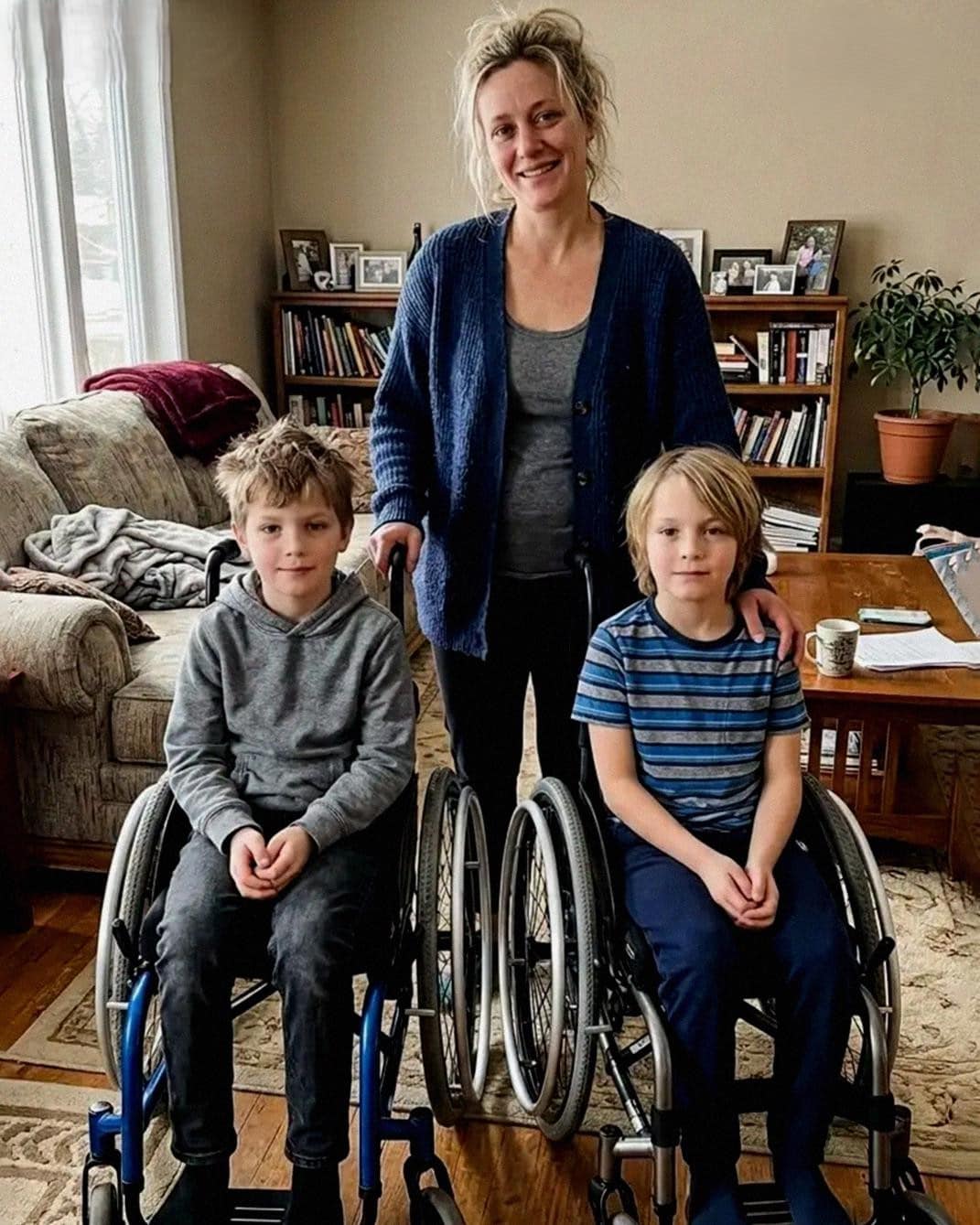
I used to measure my days by the rhythm of my sons’ medications.
At seven each morning, Lucas needed his muscle relaxants. Fifteen minutes later came Noah’s seizure medication. By eight, we were stretching stiff muscles and preparing for another day that required more strength than I ever thought I possessed.
By nine in the morning, I often felt as if I had already worked an entire shift.
Three years earlier, everything in our lives had changed.
Lucas and Noah, my twin boys, had been in a car accident while my husband Mark was driving them home from school. The boys survived, but the crash left both of them permanently disabled. Lucas struggled to move his legs, and Noah suffered brain trauma that meant he needed constant supervision.
From that day forward, our home turned into something between a hospital ward and a rehabilitation center.
Physical therapy sessions filled our calendar. Wheelchairs, bath chairs, adaptive utensils, and medication schedules became our new normal. My days revolved around lifting two growing boys who depended on me for nearly everything.
I loved them more than anything in the world. But the exhaustion was real.
Most nights I slept in fragments—three hours if I was lucky, sometimes four.
He worked for his father’s logistics company, a business Arthur had built from the ground up. For years Mark had told everyone that he would eventually take over the company.
Whenever I admitted how overwhelmed I felt, Mark gave me the same reassuring promise.
“Just hold on a little longer, Emily. Once I become CEO, everything will change. We’ll hire full-time nurses. You won’t have to do this alone.”
Arthur was approaching retirement, and Mark had always seemed like the obvious successor. Long hours felt like part of the path toward that goal.
But after the accident, those long hours became endless.
Mark suddenly had late meetings. Weekend trips for “client dinners” that stretched into midnight.
At first I tried to be understanding. But slowly, little things began to feel wrong.
One evening, about six months before everything fell apart, Mark came home smelling of expensive perfume.
I stood in the kitchen holding Noah’s feeding syringe.
“That’s a new cologne,” I said carefully.
“It’s a client dinner, Emily,” he replied casually. “Restaurants smell like perfume. Relax.”
I wanted to believe him, so I swallowed my doubt.
Hotel receipts when he claimed he had stayed at the office. Text alerts lighting up a phone he always kept face down.
And the biggest change of all was the way he stopped looking at me.
I knew how I looked these days. Dark circles under my eyes. Wrinkled clothes from lifting wheelchairs all day. Hands that smelled faintly of antiseptic.
Then came the Wednesday that broke everything.
That morning I had thrown out my back helping Lucas transfer from his wheelchair to the couch. Still, I pushed through the pain. I made breakfast, ran Noah through his speech exercises, and tried to keep the routine intact.
He was adjusting the water from his shower chair when his arm lost grip on the safety rail. The chair tipped slightly, and he slid to the floor.
I tried to lift him, but my back screamed in protest.
Seventeen calls. Every one went to voicemail.
Eventually, my neighbor Dave rushed over and helped me lift Lucas into bed. My son kept apologizing through tears.
Mark finally walked through the door at ten that night.
“I called you seventeen times,” I said, stunned.
“I was in meetings,” he replied with a shrug before heading for the shower.
While he was gone, his phone lit up on the bedside table.
The message preview appeared before I could look away.
“That hotel view was almost as good as you. Can’t wait for our weekend trip.”
When he came out of the bathroom, I held up the phone.
For a moment he looked irritated that I had touched it. Then he sighed.
“It’s Jessica. We’ve been seeing each other.”
The words landed harder than the accident ever had.
“What about your family?” I asked quietly.
“They’re still my sons,” he said dismissively.
“Emily, look at you. You smell like antiseptic all the time. You’re exhausted. You only talk about medications and therapy schedules.”
“And I’m trying to build a future,” he snapped.
Then he said the sentence that shattered what remained of our marriage.
Something inside me went silent that night.
Two days later, Mark’s father Arthur came to visit the boys.
He sat on the living room floor cheering as Lucas slowly lifted his leg with a resistance band.
“Look at that strength!” he said proudly.
Watching their grandfather celebrate them more than their own father ever had became too much. I slipped into the kitchen.
Arthur followed a few minutes later and found me crying.
“Emily,” he asked gently, “what’s wrong?”
The truth spilled out before I could stop it—the affair, the hotel messages, Lucas’s fall.
When I finished, his expression had turned cold.
“Tomorrow morning,” he said slowly, “I’m calling Mark to headquarters. I’ll tell him he’s becoming CEO.”
The next morning I stood outside Arthur’s office door.
Later Arthur told me exactly what happened.
After announcing Mark’s promotion, he turned on the conference screen.
“These were submitted as client meetings,” Arthur told the board.
“As of this morning,” he said calmly, “you no longer work here.”
“Your shares are being transferred into a medical trust for my grandsons.”
“It was never your company,” Arthur replied.
“I want to say something,” I said quietly.
“I actually came here planning to help you,” I continued. “I thought if Arthur gave you a small job, you might stay involved in Lucas and Noah’s lives.”
“But after hearing you say you planned to send them to a facility…”
“I’ve already spoken to my attorney. I’m prepared to adopt Lucas and Noah if Emily agrees.”
Moments later, he collapsed from stress and dehydration.
Paramedics arrived quickly. He would recover.
Jessica faced consequences as well. After the board investigation, she was removed from her position and reassigned far from leadership offices.
Within weeks, Arthur finalized the boys’ medical trust.
Three nurses began rotating shifts at our house.
One evening, I watched from the kitchen as a nurse helped Lucas practice standing.
“I slept six hours,” I replied with a smile.
A month later, I boarded a train for a quiet spa retreat while the nurses cared for the boys.
As the train rolled away from the station, I leaned back and closed my eyes.
For the first time in years, the constant tension had lifted.
I looked out the window at the fading sunset and realized something I had almost forgotten.