
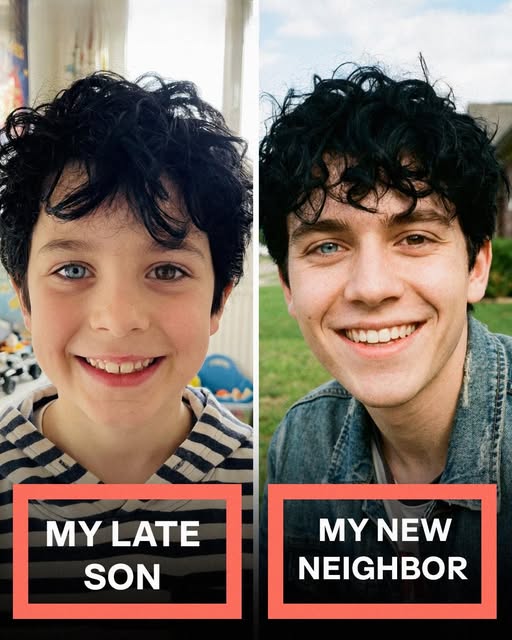
For ten years I lived with a truth that shaped every quiet corner of my life: I believed I had buried my son.
Daniel was nine when the accident happened. One careless moment near the school gate, a car moving too fast, a child chasing a ball the way children do. In an instant laughter ended, and a silence settled over our home that never quite lifted.
People often say time heals. But grief rarely behaves that neatly. It doesn’t vanish. It simply changes its weight, becoming something you learn to carry through ordinary days.
Carl and I became quiet people. Our house remained tidy, our routines steady, but joy often moved somewhere else.
Then one afternoon a moving truck pulled into the house next door.
Carl stood at the window watching strangers unload furniture.
“Looks like we’ve got neighbors again,” he said.
I nodded and did what I always did in moments like that.
I made an apple pie, the kind Daniel loved when he was small. The smell filled the kitchen and stirred memories I usually kept folded away.
When it cooled, I carried it across the lawn.
The plate slipped from my hands before I even knocked.
And when I looked up, I forgot how to breathe.
Curly hair. A familiar shape to his face. And eyes that made the world tilt for a moment—one blue, one brown.
Daniel had inherited that rare trait from my mother.
“Oh—are you okay?” the boy asked gently, stepping around the broken plate.
His voice was older than Daniel’s would have been, but the resemblance was enough to shake something deep inside me.
He shrugged. “A neighbor dropped something.”
Hearing him say Mom to someone else sent a quiet ache through me.
“I’m sorry,” I said. “My son… if he had grown up, he might have looked like your boy.”
“I’m sorry for your loss,” she replied quickly. “We’re very busy today.”
She gently guided him back and closed the door.
The silence afterward felt heavier than before.
When I stepped inside my own house, Carl was sitting with a book.
“Carl,” I said slowly, “the boy next door… he looks like Daniel.”
The color left his face in a way I had never seen before.
“I thought…” he murmured. “I thought that part of the story was buried.”
“When Daniel was born,” he said quietly, “he wasn’t alone.”
“You were unconscious after the delivery. The doctors were trying to stabilize you. One baby was healthy—Daniel. The other was struggling to breathe.”
“They rushed him to intensive care,” Carl continued. “A social worker spoke to me. They said some families were willing to adopt babies with uncertain survival chances.”
My voice came out barely above a whisper.
“You were fighting for your life,” he said. “I didn’t know if either baby would survive. When you woke up, they told me only one had made it.”
“Later they called. The baby was improving. The social worker said a couple had already begun the adoption process.”
“I thought I was sparing you another loss,” he said quietly.
Finally I said, “Then we need to go back next door.”
The woman opened the door again, and recognition passed through her expression immediately.
“Nineteen years ago,” I said gently, “did you adopt a baby through a hospital placement program?”
Behind her, the boy—Tyler—stepped forward.
“We knew this moment might come someday,” he said softly.
They explained everything. Tyler had spent months in neonatal care before he was strong enough to come home. They had been told the biological parents believed the baby would not survive.
Tyler listened to the story with quiet intensity.
“That’s strange,” he said finally. “The healthy twin was the one who died… but I’m the one who lived.”
His adoptive mother placed a protective arm around him.
In that moment I understood something clearly.
Whatever blood connected us, she had been his mother through every day that mattered.
That realization hurt—but it also carried a kind of clarity.
That evening there was a knock on our door.
When I opened it, Tyler stood there looking uncertain.
“I don’t know what to call you,” he admitted.
“You can call me Sue,” I said. “That’s enough for now.”
We sat together in the living room for a long time.
I showed him Daniel’s photographs—his drawings from kindergarten, the spelling bee he won, the way he laughed so hard he snorted.
Tyler listened carefully, as if piecing together a story that had always been missing a chapter.
For the first time in many years, the tears that came were not only grief.
There was sorrow still, and regret, and many questions.
But there was also something quieter beginning to grow.
Simply the possibility that even after long silence, life can still bring unexpected connections—ones that ask for patience, honesty, and time.
And sometimes, if hearts remain open, those small beginnings can slowly become a kind of healing.