
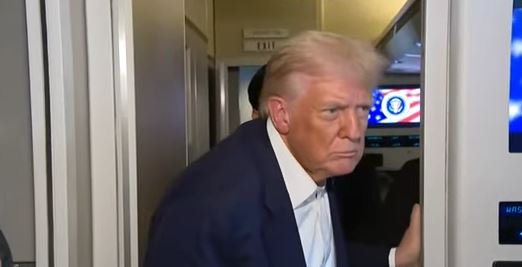
Alexandria Ocasio-Cortez issued a sharp public rejoinder after President Donald Trump challenged her to take what he described as a “very hard” cognitive or IQ-style test, a boast he delivered while deriding her intelligence and that of fellow Democratic congresswoman Jasmine Crockett. Speaking to travelling reporters aboard Air Force One earlier this week, Trump, 79, recounted that he had recently undergone examinations at Walter Reed National Military Medical Center and suggested that Ocasio-Cortez would fail the same assessment, remarks that reignited a long-running back-and-forth over his mental fitness and the accuracy of his claims about the nature of the exam. In a widely shared post on X, Ocasio-Cortez responded: “Hello Mr. President! Out of curiosity, did those doctors ask you to draw a clock by any chance? Was that part hard for you, too? Asking for 340 million people.” The quip refers to a common task in cognitive screening tools used to evaluate memory, executive function and visuospatial abilities, and it framed Trump’s comments as evidence of confusion about the distinction between screening for impairment and measuring intelligence.
Trump’s latest comments reprised a theme he has returned to periodically since his first term: presenting the Montreal Cognitive Assessment—or a similar screening tool—as a proxy for superior intellect. During the exchange aboard Air Force One, he called the test “very hard,” portrayed it as an “aptitude” or IQ-style exam, and asserted that Ocasio-Cortez and Crockett would be unable to complete later questions. The president also labelled both lawmakers “low IQ,” renewing a pattern of personal attacks that he frequently pairs with declarations about his own mental sharpness. In past accounts of the screening, Trump has emphasised the increasing difficulty of later tasks and has described early questions as identifying animals or recalling words, details that mirror publicly available descriptions of the MoCA. Medical experts have consistently noted that the MoCA is not an intelligence test but a screening instrument to detect potential cognitive decline that may warrant further evaluation.
Ocasio-Cortez’s reply drew immediate attention because it undercut the premise of Trump’s challenge while staying within the bounds of publicly verifiable details about common screening tasks. The congresswoman, a 35-year-old New York Democrat first elected in 2018, has often used social media to counter Trump’s attacks in real time, and her post echoed earlier episodes in which she has questioned the president’s claims without engaging in invented quotations or unsubstantiated assertions. Her response also aligned with a broader chorus of critics who, over several years, have objected to Trump’s conflation of cognitive screening with measures of intelligence and who have argued that boasting about such a screening misunderstands its purpose.
Independent reporting about the president’s remarks this week emphasised that the evaluation he referenced is designed to flag possible impairment rather than to rank intellectual ability. The MoCA typically includes tasks such as clock drawing, naming animals, recalling a short list of words after a delay, copying a cube, counting backwards by sevens, and connecting alternating sequences of numbers and letters. Clinicians use scores as one data point in a broader clinical picture; high scores do not equate to high IQ, and low scores do not diagnose dementia on their own. The test is administered across age groups when clinicians observe memory complaints or other concerns, and it is commonly repeated to track changes over time. These clinical facts have often been cited by physicians who have responded to Trump’s earlier public statements about the assessment, including the test’s creator, Dr Ziad Nasreddine, who has previously clarified that the MoCA does not measure intelligence.