
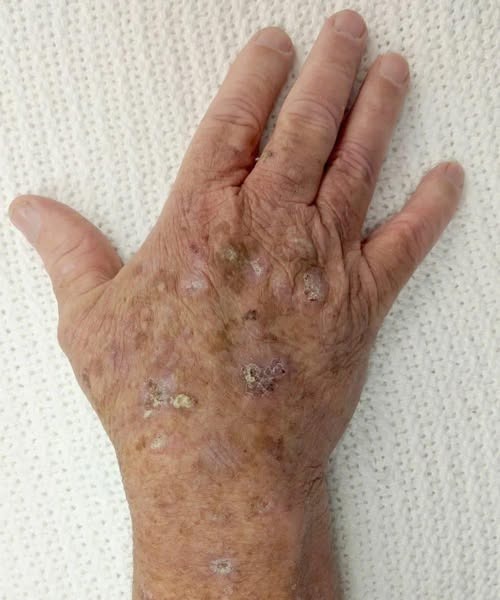
The human skin tells our life story — every freckle, scar, and line is a record of years spent under the sun. But sometimes, beneath those ordinary changes, something more serious begins to form. What starts as a dry patch, a faint flake, or a rough little spot that won’t go away can be the body’s quiet warning that cells have been damaged by ultraviolet light. These spots, called actinic keratoses, are among the most common precancerous skin lesions in the world. They develop slowly, painlessly, and often without notice — yet they represent the earliest visible stage of skin cancer formation.
For millions of adults, especially those over fifty, recognizing these subtle changes could literally save their lives. Early detection of actinic keratosis not only prevents it from turning into squamous cell carcinoma, one of the most common types of skin cancer, but also serves as a wake-up call about the cumulative effects of sunlight on our bodies. Understanding the first signs — and acting quickly — is one of the most powerful forms of preventive medicine we have.
Sunlight is essential for life. It gives warmth, energy, and the Vitamin D our bodies need to function. Yet within sunlight are invisible ultraviolet (UV) rays — UVA and UVB — that can damage the DNA inside skin cells. Over time, especially after decades of outdoor work or recreation, those microscopic injuries accumulate. The body repairs most of them, but sometimes a few cells slip through unchanged. Those cells can begin dividing abnormally, forming what doctors call solar keratoses, or actinic keratoses.
Actinic keratoses (often shortened to AKs) are most common on sun-exposed areas: