
I used to believe that if you worked hard enough, “enough” would eventually stop feeling like a question.
Enough food. Enough warmth. Enough stability to breathe without doing math in your head every time you opened the fridge.
But in our house, “enough” was something I negotiated daily—with grocery lists, with overdue bills, with quiet sacrifices no one talked about out loud.
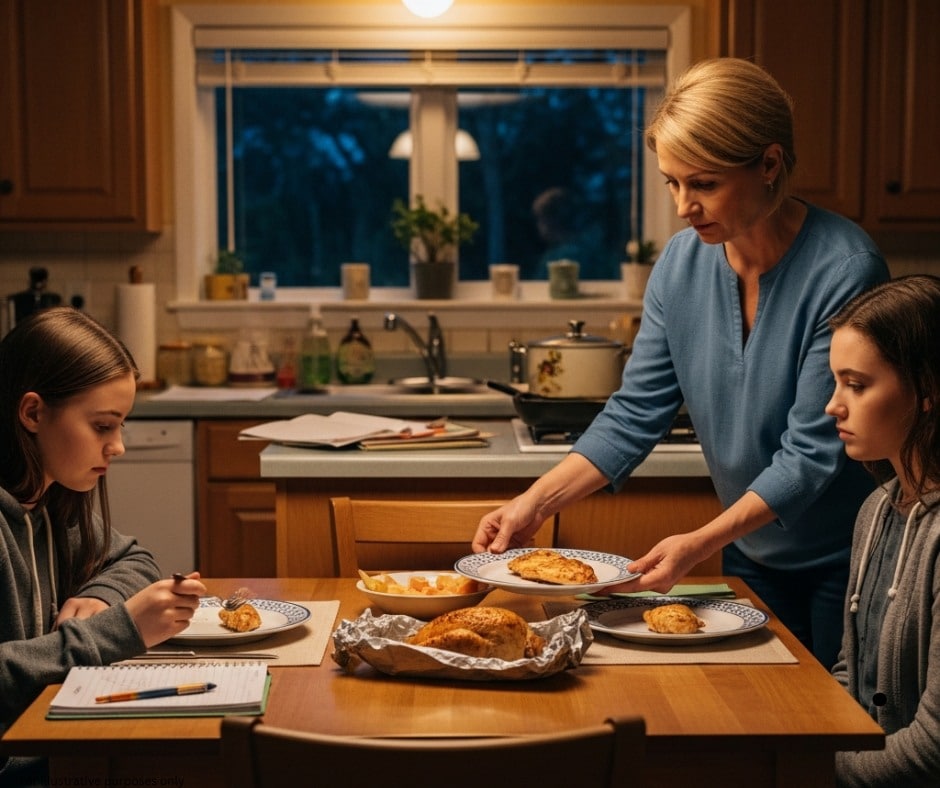
Tuesday nights were always the same. Rice, chicken thighs, carrots, and half an onion stretched just far enough to make it through dinner and maybe into tomorrow’s lunch. As I chopped, I was already calculating—who would take less, what could be saved, which expense could wait one more week.
Dan came in from the garage, tired in a way that never really left his face anymore.
“Ten minutes,” I said, still doing the math.
Three plates. Maybe a fourth if we were careful.
I was about to call them when the door burst open and Sam walked in—followed by a girl I’d never seen before.
She didn’t ask. She said it like it was already decided.
The girl stood behind her, small in a way that didn’t match her age. Hoodie sleeves too long, shoulders slightly hunched, eyes fixed on the floor like she was trying to disappear.
For a second, I just stared. Not at her—but at the pot on the stove.
Then I forced a smile. “Of course. Come in, sweetheart. Grab a plate.”
She hesitated before moving, like she needed permission twice.
At the table, she didn’t eat the way kids usually do. There was no rushing, no second servings, no casual conversation between bites. She measured everything. One scoop of rice. One piece of chicken. Two carrots.
And she watched every movement around her, flinching at small sounds like she expected something to go wrong.
I felt it immediately—that quiet shift in the room where something wasn’t quite right.
“So, Lizie, how long have you known Sam?”
Sam jumped in quickly, filling the silence. “She’s the fastest runner in class. Doesn’t even complain.”
After dinner, Sam handed her a banana like it was nothing.
“House rule,” she said. “Nobody leaves hungry.”
The girl looked at it like it meant more than it should.
“Sam, you can’t just bring people home. We’re barely managing.”
“She didn’t eat all day, Mom. What was I supposed to do?”
I opened my mouth to argue, but she kept going.
“She almost passed out in gym. They told her to eat better—but how is she supposed to do that when there’s nothing to eat?”
I sat down slowly, the kitchen suddenly feeling smaller.
I had been worrying about stretching dinner…
And this child had nothing to stretch at all.
“I told her to come back tomorrow,” Sam added, quieter now.
The next day, I cooked extra. Not comfortably—carefully. Still measuring, still adjusting—but this time, intentionally making room.
By the end of the week, Lizie had quietly become part of our routine. Homework at the table. Dinner without hesitation. Washing dishes like she was trying to repay something no one had asked for.
But it wasn’t until her backpack fell open that everything changed.
Papers scattered across the floor—bills, coins, notices stamped in red.
I picked one up, my hands suddenly unsteady.
Sam stepped closer, reading over my shoulder.
Lizie’s voice cracked. “My dad said not to tell anyone.”
And in that moment, everything made sense—the way she ate, the way she moved, the way she looked like she was always bracing for something.
She was carrying fear no child should carry.
When he walked in, he looked like a man who had been trying to hold everything together with nothing left to hold it with.
“I thought I could fix it,” he said. “If I just worked more…”
“She needs more than that,” he said quietly. “She needs help.”
Phone calls. School meetings. Food banks. Conversations that were uncomfortable but necessary. Pride that had to be set aside piece by piece.
But something shifted in the way I saw things.
Stopped seeing “one more plate” as a problem.
She laughed more. Spoke louder. Sat without shrinking into herself. Helped Sam with math. Started acting like a kid again—slowly, cautiously, but undeniably.
One evening, she lingered in the kitchen after dinner.
“I used to be scared to come here,” she admitted.
I handed her a packed lunch for the next day.
She hugged me tightly. “Thank you… for everything.”
The next night, Sam walked in laughing, Lizie right behind her.
“Rice,” I said. “And whatever I can stretch.”
And for the first time in a long time, “enough” didn’t feel like a calculation.